You face six decision areas when you choose an OEM aerosol packaging partner: partner capability, technical performance, application fit, regulatory compliance, cost structure, and a disciplined comparison process. Evaluate validated quality systems and multi-market regulatory fluency first. Confirm valve, can, and propellant compatibility against your formulation before you commit. Weigh total cost of ownership—freight, duties, lead times, and changeovers—over unit price. SiHai supports this structured approach with documented systems and global experience.
| Metric | Value |
|---|---|
| Global aerosol cans market size (2023) | USD 11.1 Billion |
| Projected market size (2032) | USD 16.8 Billion |
| CAGR (2024–2032) | 4.8% |
| Largest regional market | Europe |
| Fastest-growing region | Asia-Pacific |
A structured comparison framework turns these factors into a defensible sourcing decision for OEM aerosol packaging.
Key Takeaways
- Check a partner's quality certifications and production capacity first. This ensures they can consistently meet your specifications and grow with your brand.
- Test the valve, can, and propellant with your actual formula before you commit. This prevents failures and protects your brand's reputation.
- Compare total costs, including freight and lead times, not just unit price. A slightly higher price with reliable delivery often saves money overall.
Selecting the Right OEM Aerosol Packaging Partner

You select an OEM aerosol packaging partner on evidence, not on a price sheet. Three capability pillars carry the most weight in that evaluation: quality systems, production capacity, and supply chain reliability. Each pillar answers a different question. Quality systems tell you whether the partner can repeat a specification. Capacity tells you whether the partner can grow with your brand. Supply chain reliability tells you whether the partner can deliver on the date promised. SiHai builds its OEM aerosol packaging programs around all three pillars, with documented systems behind each one.
Quality Systems and Certifications
Start with certifications. They give you an independent signal that a supplier operates under recognized controls. Two credentials matter most when you vet an aerosol packaging manufacturer:
- ISO 9001 — a quality management system certification confirming compliance with global quality standards, recommended when selecting an aerosol filling company.
- National and international regulatory compliance — adherence to applicable laws, illustrated by EPA requirements for household products and FDA requirements for personal care products.
A certificate alone proves little. You need to understand what sits behind it. ISO 9001 requires a supplier to operate a documented quality management system: processes from raw material receipt to shipping finished can ends must be defined, employees trained, machinery calibrated, non-conforming products handled, and improvement driven through a Plan-Do-Check-Act cycle. This systematic approach yields predictability and reliability—unlike an artisan working from instinct, the certified supplier works from a blueprint with calibrated tools and stage-by-stage checks. The standard itself does not set a quality level; it guarantees the supplier can repeatedly meet whatever specification is agreed, so you must still define your own quality requirements.
ISO 14001 establishes an environmental management system covering energy use, waste reduction, chemical handling, and regulatory compliance. For aerosol can component makers this means measuring environmental interactions, setting objectives and targets, and minimizing negative impacts. For you as a buyer, this lowers supply chain risk from environmental non-compliance—such as fines or shutdowns that could interrupt production—and aligns your brand with a responsible partner. Ask suppliers to show concrete, measurable targets, such as water use per million can ends or recycled content in waste streams. Those numbers prove genuine commitment rather than a superficial certificate.
| Certification | Primary Focus | Key Benefit for the Buyer | Vetting Question Example |
|---|---|---|---|
| ISO 9001 | Quality Management & Consistency | Predictable product quality and reliability | “Can you describe a recent process improvement initiated through your 'Plan-Do-Check-Act' cycle?” |
| ISO 14001 | Environmental Management | Reduced supply chain risk and brand alignment with sustainability | “What are your current, measurable targets for reducing energy consumption or waste output?” |
SiHai maintains documented quality systems across its aerosol packaging operations and supports buyer audits at each stage of qualification. Request the certificate scope, not just the certificate. Check that the scope covers the specific processes your product needs, such as lithography, lining, and valve assembly.
Production Capacity and Scalability
Capacity determines whether your partner can absorb your growth without a quality dip. Ask for hard numbers and verify them against your forecast. A large-scale OEM operation typically looks like this:
| Metric | Value |
|---|---|
| Production base area | 40,000 ㎡ |
| Advanced production lines | 20 |
| Annual production capacity | 120 million units |
| Daily output | 300,000+ units |
These figures matter most during demand spikes. Seasonal programs, promotions, and retail launches compress your delivery windows. A partner with scale handles that pressure without breaking schedules:
The manufacturing footprint is set up to handle ongoing programs, promotions, and seasonal demand while maintaining consistent product quality. Processes focus on repeatable performance, so brands and retailers can plan around dependable supply rather than one off runs.
Scalability also depends on component availability. Capacity scalability depends less on overall demand growth and more on whether critical components can be procured with predictable timing and documentation. This reality emphasizes qualified suppliers, controlled change management, and routing that balances cost per unit with risk of line interruption. In Household channels, scale and service-level targets encourage more frequent ordering patterns and safety stock planning for high-turn items, while bag-in valve supply can be constrained when actuator compatibility and system verification become gating factors. Trade flows translate these operational constraints into market outcomes, affecting landed cost, inventory strategy, and responsiveness to seasonal demand in Personal Care & Cosmetics and Household applications. Where logistics constraints are higher, buyers respond with longer planning horizons and inventory buffers, smoothing availability but raising working-capital exposure. SiHai plans capacity around your program calendar, so seasonal peaks enter the production schedule as planned events rather than emergencies.
Supply Chain Reliability and Lead Times
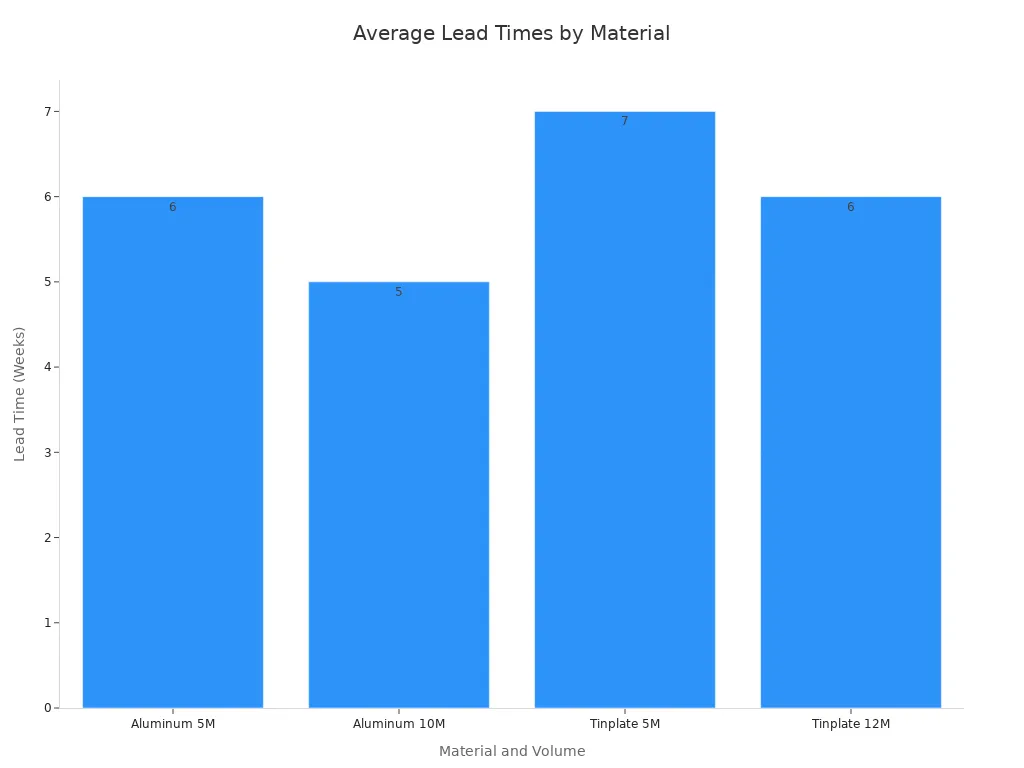
Lead time is a promise you pass to your own customers. Treat it as a contract term, not an estimate. Typical OEM lead times vary by material and volume:
| Material | Avg Bulk Volume (Million Units) | Lead Time (Weeks) |
|---|---|---|
| Aluminum | 5 | 6 |
| Aluminum | 10 | 5 |
| Tinplate | 5 | 7 |
| Tinplate | 12 | 6 |
Order structure changes the picture. For OEM/private-label aerosol programs (minimum 7,500 pcs), the typical lead time is 3–20 days once packaging, artwork, and order details are confirmed. Custom lithographed orders (proofing, production, curing) typically require 4–6 weeks; stock plain cans ship immediately from inventory. Sample timelines run separately from production. SiHai quotes 7–15 days for simple samples and 15–30 days for complex or tooled samples, with 5–10 business days per round for standard or custom formulations across 2–3 rounds. Build these sample cycles into your launch plan, because they gate the production start date.
Disruptions test every lead time commitment. Supply chain visibility ranks as a top concern for U.S. manufacturers, and poor visibility during disruptions makes lead times harder to predict and manage. One operations manager puts the stakes plainly: “If you can't trace the can, you can't protect the brand.” A single delayed pallet of blank aerosol can stock can freeze an entire filling shift. If logistics freeze or capacity tightens, the empty spray can line slows down fast. Mitigate this risk by syncing inventory management with lead times and delivery schedules, and set safety stock based on average weekly usage and supplier lead time versus production forecasts. SiHai supports this discipline with traceable shipments and documented delivery schedules, so you can plan around dependable supply.
Technical Performance and Application Fit

Technical validation protects your brand. Confirm every component against your real formulation before you commit to OEM aerosol packaging.
Valve, Actuator, and Can Compatibility
Valve and actuator mismatches cause most aerosol failures. Watch for these common issues:
| Compatibility Issue | Cause | Mitigation |
|---|---|---|
| Material incompatibility | Valve material mismatched with acidic or solvent-heavy contents | Use chemically resistant gaskets and coatings |
| Clogging | Thick formulas drying in the stem | Use self-cleaning actuators or wider orifices |
| Inconsistent spray | Poor pressure regulation or weak springs | Test spring tension and verify uniform filling |
Actuator orifice size and shape control dispensing rate and spray pattern. Test actuators across temperatures and pressures to confirm reliability. SiHai verifies each assembly step for alignment, crimping, and material fit.
Propellant and Formulation Considerations
Propellant rules are tightening worldwide. The U.S. EPA restricts higher-GWP HFCs in aerosols from January 1, 2025. The EU F-gas Regulation cuts HFC quotas from 2024 onward. The Kigali Amendment targets a phase-down of more than 80% over 30 years. Low-GWP alternatives such as dimethyl ether and HFO-1234ze(E) now lead the transition.
Formulation chemistry constrains propellant choice. Viscosity must match propellant vapor pressure and valve geometry to achieve your target spray. Adjust pH to roughly 7.6–8.8 to reduce corrosion, and minimize chloride ions. Gasket compatibility requires immersion testing with the actual formula, not surrogate solvents.
Matching Packaging to Product Categories
Household and industrial products demand different specifications. Household cleaners need higher flow-rate valves and wide actuator inserts for surface coverage. Industrial aerosols need controlled flow to prevent clogging and waste. Personal care formats favor aluminum cans with premium finishes. Match can material, valve flow, and propellant behavior to your category before scaling.
Compliance, Cost, and Comparison for OEM Aerosol Packaging
Compliance, cost, and comparison form the final gate before you sign a sourcing agreement. Each one carries its own risk profile. Regulatory gaps can block market access. Hidden cost drivers can erode your margin after launch. A weak comparison process can leave you defending a decision you cannot document. SiHai helps you close all three gaps with documented compliance support, transparent cost modeling, and structured evaluation tools.
Regulatory Requirements Across Global Markets
Aerosol packaging crosses multiple regulatory regimes at once. You must map every market you sell into before you finalize a supplier. The European Union offers a clear example of how layered these requirements become.
Pressure packaging safety sits under Directive 75/324/EEC and its technical annex. This directive sets design criteria, limits, tests, and marking rules for safe manufacturing, transport, storage, and use. Directive (EU) 2016/2037 later updated its labeling provisions to align with the CLP Regulation. That update created a harmonized system of pictograms, H and P phrases, warnings, and classification criteria across the EU market.
Chemical content adds another layer. The CLP Regulation governs classification and labeling. REACH governs information obligations and safety data sheets. Both frameworks drive formulation decisions, labeling choices, SDS documentation, and market access for aerosol products. REACH itself rests on four pillars:
- Registration — required for substances at or above 1 tonne per year.
- Evaluation — authorities assess submitted data and substance risks.
- Authorization — applies to Annex XIV substances of very high concern.
- Restriction — Annex XVII sets limits or bans on specific substances.
Horizontal legislation completes the picture. Waste and packaging regulations, dangerous goods transport rules for road, sea, and air, and occupational risk prevention rules all affect aerosol products. The PPWR is not specific to aerosol dispensers, but it applies to packaging materials and components used in the aerosol industry. You should assess secondary packaging, plastic components such as caps and actuators, packaging artwork and labeling, and supplier documentation. You may need to demonstrate compliance with recyclability, recycled content, labeling, and documentation requirements.
Propellant regulation is shifting fast. Regulation (EU) 2024/573, approved in February 2024, repealed the previous 517/2014 framework and strengthens control over fluorinated greenhouse gases. This regulation directly conditions propellant options and transition strategies for aerosols.
Regulation (EU) 2024/573, approved in February 2024, repealed the previous 517/2014 framework and strengthens control over fluorinated greenhouse gases, conditioning propellant options and transition strategies for aerosols.
SiHai tracks these regulatory developments across its OEM aerosol packaging programs and provides the documentation you need for market entry. Ask every candidate supplier for a market-by-market compliance map. A partner who cannot explain the EU framework in detail will struggle with other regions too.
Cost Drivers and Total Cost of Ownership
Unit price is the smallest part of your real cost. Total cost of ownership captures everything from freight to changeovers, and it determines your true cost efficiency. Build your cost model around these drivers:
- Freight and logistics — distance, mode, and volume affect landed cost per unit.
- Duties and tariffs — cross-border flows add layers that unit price never shows.
- Lead times — longer lead times tie up working capital and raise inventory carrying costs.
- Changeovers — each SKU switch consumes line time and adds setup cost.
- Safety stock — supply variability forces buffer inventory that raises working-capital exposure.
- Quality failures — rework, returns, and line stoppages erase any unit-price savings.
A low unit price from a distant supplier often loses to a higher unit price from a partner with shorter lead times and reliable delivery. Model both scenarios before you decide. SiHai supports this analysis with transparent quotes that separate tooling, production, and logistics costs, so you can compare offers on equal terms.
Building a Side-by-Side Comparison Matrix
A comparison matrix turns scattered impressions into a defensible decision. Build it before you request quotes, and score every candidate against the same criteria. Include these rows in your matrix:
| Criterion | What to Verify |
|---|---|
| In-house finishing capability | Confirm which finishing services are done on-site versus outsourced; in-house work avoids transit risk and vendor coordination |
| Label application compatibility | Check equipment compatibility with your can diameter, label dimensions, and label material (pressure-sensitive, heat-applied, shrink sleeve) |
| Lot-coding method and traceability | Identify coding method (inkjet, laser, hot stamp), code location, and batch-record documentation — a compliance requirement for regulated categories |
| Retailer compliance experience | Assess familiarity with case count, case label format, pallet configuration, and retailer-specific vendor documentation |
| Quality management system and certifications | Verify scope covers full operations, finished-goods inspection, non-conforming product handling; check SQF, ISO 22716 GMP, and FDA registration |
| Capacity at both ends | Confirm lines keep pace at launch volume and can scale with anticipated growth |
| Single point of accountability | Confirm responsibility for the finished packaged unit, not just the filled can, with matching quality release documentation |
| Relevant certifications | SQF (food-contact), ISO 22716 GMP (cosmetics), FDA registration (OTC drugs), EPA Establishment Registration (pesticides) |
Weight each criterion against your program priorities. A launch-focused brand may weight capacity and lead time higher. A regulated category may weight certifications and traceability higher. Document your weights and scores, because a transparent matrix protects your decision when stakeholders challenge it.
Pair the matrix with a technical validation sequence. Define net quantity, dose, discharge rate, and consumer-use requirements first. Document formulation properties, propellant type, density, thermal expansion, and compatibility risks next. Shortlist suitable diameter, length, and capacity combinations. Select coating, valve, gasket, dip tube, actuator, cap, and shoulder as one system. Confirm filling-line limits, change parts, and inspection settings. Calculate carton, pallet, storage, and transport implications. Validate the final pack using actual components and formulation.
Run the supplier evaluation in parallel. Define requirements such as production volume, product types, and budget constraints. Evaluate quality through advanced technologies such as servo-driven systems and PLC controls. Check reputation through industry experience, certifications, and customer references. Compare value through total cost of ownership, not just price. Inspect facilities on-site to assess production capabilities and quality control.
SiHai welcomes on-site audits and provides the batch records, certification scopes, and traceability documentation your matrix requires. A partner who supports this level of scrutiny gives you the evidence you need to defend your sourcing decision.
Weigh all six decision areas together. Partner capability and compliance fluency form the foundation of a sound OEM aerosol packaging choice. Technical validation and application fit protect your brand reputation in every market. Evaluate total cost of ownership and score candidates with a weighted comparison matrix. Define requirements, request samples and documentation, audit facilities, and pilot before scaling. SiHai supports each step with documented quality systems and multi-market experience.
FAQ
How do you choose an OEM aerosol packaging manufacturer?
You verify quality certifications, production capacity, and supply chain reliability first. Then you confirm valve, can, and propellant compatibility against your formulation. SiHai supports each step with documented systems and audit-ready records.
What lead time should you expect from an OEM aerosol packaging partner?
You can expect 3–20 days for private-label orders after confirmation. Custom lithographed cans typically take 4–6 weeks. SiHai quotes sample timelines separately, so you can plan your launch around confirmed dates.
Which regulations apply to aerosol packaging across global markets?
You must map EU pressure equipment rules, CLP and REACH labeling duties, and propellant restrictions such as Regulation (EU) 2024/573. SiHai provides market-by-market compliance documentation to support your entry into each region.