Aerosol mechanics, market appeal, technical and environmental considerations, customization, safety, and cost-effectiveness decide whether your product launches smoothly or stalls. The aerosol cosmetics market reached USD 5.21 billion in 2024 and should hit USD 9.78 billion by 2033. Each factor maps to a practical decision you face, from cosmetic aerosol packaging to propellant choice. SiHai supports every step with reliable components and expert guidance.
Key Takeaways
- Aerosol products work when all parts—propellant, formula, container, and valve—match perfectly. Test your full package early to ensure consistent spray and performance.
- Consumers love aerosols for their convenience and even delivery. Choose the right format and customize spray patterns to create a memorable brand experience.
- Sustainability and safety are non-negotiable. Select eco-friendly propellants and recyclable containers, and follow all labeling and testing rules to launch smoothly.
How Aerosols Work

The Basic Mechanism
You fill a sealed container with a product concentrate and a propellant. The propellant pressurizes the container. When you press the actuator, the valve opens and the pressure forces the concentrate out. The propellant then atomizes the product or turns it into foam. Liquefied gases such as LPG hold pressure in liquid form. Compressed gases such as CO2 and nitrogen stay gaseous throughout. This pressure balance governs spray force, delivery rate, and internal pressure. A stable balance gives you consistent performance from the first spray to the last.
Key Components of an Aerosol System
Every aerosol system relies on four core parts working together:
- Propellant – pressurizes the container and ejects the product through atomization or foam production.
- Product concentrate – the formulation filled inside the canister.
- Aerosol container – the vessel holding the pressurized contents.
- Valve and actuator – the mechanism controlling discharge. The actuator sets the pattern and flow. Valve sub-parts include the stem, stem gasket, spring, housing, dip tube, and mounting cup.
Each part must match the others. The concentrate must stay chemically stable under pressure and compatible with valve elastomers. The container must withstand pressure, shock, and temperature changes. SiHai supplies valves, actuators, and containers engineered for this balance, so your formula performs as designed.
Why Aerosols Appeal to Consumers
Convenience and User Experience
You press a button and get an even dose every time. That single action explains much of the aerosol's hold on the beauty market. No tools, no mess, no guesswork. Consumers reach for aerosols because the package does the work for them. A fine mist covers a wide area in seconds. A foam delivers a measured amount you can spread by hand. Both formats protect the formula from air and contamination between uses. The experience feels clean, fast, and predictable. That reliability builds repeat purchase behavior, and it gives your brand a daily place in the user's routine.
Common Product Formats
Aerosol technology serves a wide spread of beauty and personal care categories. The table below maps the main formats to their physical form and function.
| Product Category | Physical Form | Primary Function |
|---|---|---|
| Deodorant & Antiperspirant Sprays | Fine Spray | Odor control & sweat management |
| Hair Sprays | Mist Spray | Hair hold & styling |
| Hair Color Sprays | Pigmented Spray | Temporary hair coloring |
| Hair Mousse & Styling Foams | Foam | Volume & curl definition |
| Other Cosmetic Aerosols (shaving foams/gels, dry shampoos, facial & body mists, sunscreen sprays, foot care) | Spray / Foam / Mist | Shaving, hygiene & care |
Each format carries its own formulation logic. Antiperspirant and deodorant sprays form the largest cosmetic aerosol segment, with actives carried in alcohol and propellant systems. Hair sprays rely on film-forming polymers in ethanol and HFA propellant blends. Dry shampoos suspend starch or silica powders in hydrocarbon and HFA blends. Styling mousses use three-phase emulsion-foam systems pressurized with hydrocarbon propellant. Sunscreen sprays disperse UV filters for full-body application, and setting sprays and face mists use fine-mist actuators to deliver aqueous or alcohol-based film formers and skincare actives.
The most common aerosol formats are hair sprays (for fixing and styling, offering ease of use and even distribution), deodorants (for hygiene and practicality), and sunscreens (sprays increasingly preferred over creams). Beyond these, dry shampoos, shaving foams, and some skin care products are also offered in aerosol spray form, reflecting the wide range of aerosol technology.
Your choice of cosmetic aerosol packaging should follow the format you target. SiHai offers actuators and valves tuned to each spray and foam type, so the delivery matches consumer expectations.
Technical Considerations in Formulation
Formulation work decides whether your aerosol performs as intended or fails at the nozzle. You must match the concentrate to the delivery system, then choose a propellant that supports both the formula and the spray. These two decisions connect directly. A change in one forces a review of the other.
Matching the Formula to the Delivery System
Your formula's physical properties set the limits for valve and actuator choice. Viscosity governs how a spray breaks up into droplets. Cohesive forces within the formulation (viscosity, surface tension, density) resist droplet breakup, while aerodynamic forces at the nozzle (propellant expansion, shear) disrupt the liquid. When viscosity is too high or propellant pressure too low, atomization fails. You get large droplets, spitting, or a stream discharge. Low viscosity combined with high propellant levels yields highly atomized sprays with very small droplets. You must balance these parameters to achieve the desired spray pattern while controlling the generation of respirable fine particles.
Particle size matters just as much, and its effect depends on the product type:
- Inhalation products: deposition in the respiratory tract is highly size-dependent. Particles in the 1–5 µm range are typically required for deep lung delivery, and deviations can reduce therapeutic outcomes or cause deposition in unintended airway regions.
- Oral suspensions: particle size governs sedimentation rate, redispersibility, and suspension stability. Larger particles settle faster, while very fine particles may form hard sediments, so you need a balanced size distribution for uniformity over shelf life.
- Stability considerations: reducing particle size increases surface energy, which can drive aggregation or Ostwald ripening in suspensions. Stabilizers and surfactants often mitigate these risks.
Once you understand your formula's behavior, you can select the delivery system that fits it. The table below maps common formula characteristics to matched valve systems and the component adjustments each one needs.
| Formula Characteristic | Matched Valve / Delivery System | Component Adjustments |
|---|---|---|
| Low-viscosity formulations | Continuous spray valve | Actuator orifice diameter tuned for mist quality; spray pattern design; stem flow channel sizing; housing pressure balance for hydrocarbon propellant |
| Oils and viscous liquids | Tilt action valve | Angled stem to reduce clogging; dip tube diameter and gasket hardness adjusted for steady output |
| Contamination-sensitive / industrial goods | Bag-on-Valve (BOV) | Product separated from propellant by inner bag; outer can pressurized with air or nitrogen; sealed valve assembly |
| Pharmaceutical / precise dosing | Metering valve | Metering chamber volume; spring tension calibration; gasket compatibility (EPDM for water-based, Buna-N for oil blends); crimp seal integrity |
| Water- and alcohol-based formulations | Polypropylene stems with Buna-N gaskets | Chemical resistance and secure sealing; reduced micro-leak paths; controlled spray output |
Bag-on-Valve deserves a closer look because it solves several formulation problems at once. BOV separates product from propellant using a multi-layer laminated bag, pressurized externally by compressed air or nitrogen. Formulators select BOV when the product is oxygen-sensitive (oils, botanical extracts, vitamins, actives), sterile or pharmaceutical-grade, a food product requiring propellant-free clean-label compliance, a topical medical or wound care product, or a premium personal care product where purity and efficacy matter. BOV also supports the industry shift toward lower-VOC and non-hydrocarbon propellant systems, eliminating VOC emissions.
You must also align formula development with the manufacturer's component inventory. Available can sizes (aluminum and tinplate), valve styles (male and female), and actuator formats constrain packaging choices. Partners offering full formulation development can optimize a formula for manufacturability alongside the selected delivery mechanism, ensuring the formula and valve/actuator system are matched before production. SiHai works this way. The company pairs valve, actuator, and container options with formulation support, so your concentrate and delivery system reach production as a matched set.
Propellant Selection and Performance
Propellant choice shapes spray quality, safety profile, regulatory standing, and cost. You should evaluate a defined set of performance attributes before you commit: flammability, toxicology, solvency, cost, availability, solvate formation, solvolytic stability, dispersancy, pressure, and compatibility. Dispersancy measures the efficiency of producing a fine spray or acceptable foam, and you can calculate blend dispersancy (an A-46 blend reaches roughly 442 mL/g at 21.1°C). Equivalent foam density or overrun is achievable with different propellants (8% CFC-12/114, 4% A-46, or 2% N2O), though N2O gives very high pressure that decreases significantly with use.
The table below compares the main propellant families on the characteristics that drive formulation decisions.
| Propellant | Pressure behavior | Flammability | Key performance notes |
|---|---|---|---|
| Hydrocarbons / LPG (propane, butane, isobutane) | Nearly constant while liquid remains; rises with temperature | Extremely flammable | Low cost, widely available; pressure set by blend ratio; consistent spray |
| Dimethyl ether (DME) | Nearly constant | Extremely flammable | Partly miscible with water; strong solvent; good for water-based personal care |
| HFCs (e.g., HFC-134a, HFC-152a) | Nearly constant | HFC-134a non-flammable; HFC-152a flammable | High GWP; restricted/phased down in many markets |
| HFOs (e.g., HFO-1234ze) | Nearly constant | Low flammability | Very low GWP; higher price than hydrocarbons |
| Nitrogen (N2) | Falls as can empties | Non-flammable, inert | No effect on scent/taste; coarser spray; headspace planning needed |
| CO2 / N2O | Falls as can empties; solubility softens drop | Non-flammable (N2O supports combustion) | CO2 can acidify water-based formulas; check corrosion |
| Compressed air | Falls as can empties | Non-flammable | Readily available; oxygen may affect oxidation-sensitive formulas |
Liquefied propellants maintain a nearly constant pressure until the can is empty, whereas compressed gases lose pressure as the can is used. The choice between them depends on the formulation, valve and can, required spray, safety, and local regulations. Each family fits a different job:
- Hydrocarbons form the largest category due to excellent spray characteristics, affordability, and broad compatibility.
- Dimethyl ether offers favorable solvency, efficient atomization, and compatibility with water-based formulations.
- Compressed gases suit applications that prioritize non-flammability and lower environmental impact.
- Fluorocarbons serve specialized applications requiring superior performance, stability, and formulation compatibility.
Compatibility between the active ingredients and the propellant can override every other consideration. Modern HFA-based aerosol systems may show limited compatibility with BHT, an antioxidant used in many formulations. The result can be phase separation, valve clogging, or altered spray patterns. Propellant selection therefore requires extensive compatibility testing across propellant systems, and that testing may restrict formulation flexibility. You need comprehensive compatibility studies with excipients, propellants, and container closure systems to ensure consistent particle size distribution and aerodynamic performance over shelf life. Potential interactions with hydrofluoroalkanes and compressed gases must be addressed early, because they drive the development strategy for stable formulations. Solubility parameters and co-solvent systems should be optimized for BHT distribution in HFA formulations, which ensures proper distribution and oxidative protection. Valve and actuator compatibility deserve the same attention in both solution and suspension systems, since device performance and delivery consistency depend on them.
A self-propelling aerosol pharmaceutical composition illustrates a workable propellant-active combination. A halogenated lower alkane serves as a non-toxic propellant, with the medicament dissolved in a liquefied propellant making up 50–90% of the composition, alongside a co-solvent and stabilizer. The result is a therapeutically effective and stable aerosol suitable for inhalation. The lesson transfers to beauty and personal care: a propellant that dissolves or disperses your actives cleanly, supported by the right co-solvent and stabilizer, gives you a stable product with predictable delivery.
Environmental regulation now shapes propellant selection as much as performance does. The table below summarizes the main regimes and their effect on your choice.
| Regulation / Regime | Effect on Propellant Selection |
|---|---|
| Montreal Protocol | Phased out CFCs due to ozone-depleting potential, driving the industry toward hydrocarbons and HFCs |
| Kigali Amendment | Commits parties to a scheduled phase-down of HFC consumption due to climate impact |
| Regional f-gas rules (e.g., EU) | Restrict high-GWP compounds in specific applications |
| VOC limits (e.g., US EPA aerosol coatings rules) | Cap evaporating organic content; since hydrocarbon propellants are VOCs, propellant choice and VOC compliance are effectively the same decision |
| Transport rules (UN 1950 / UN Model Regulations) | Aerosols ship as dangerous goods with packaging and pressure duties |
Regulatory pressure is steering propellant selection toward hydrofluoroolefins (HFOs). These resemble HFCs structurally but contain a carbon-carbon double bond that causes rapid breakdown in the lower atmosphere. HFO-1234ze is the key aerosol example, offering a global warming potential below one while preserving much of the handling behavior of HFC-134a. Three practical points follow from this regulatory landscape:
- Flammability is the primary trade-off. Hydrocarbons are flammable and may add to VOC content depending on product category and applicable rules.
- HFA-152a can mimic some hydrocarbon performance but carries different environmental and regulatory characteristics. It is costlier and itself flammable, so you choose it only when a specific formulation, environmental, VOC, or regulatory goal justifies it.
- VOC compliance depends on the propellant, product category, formulation, and applicable regulations. You must assess it during formulation development rather than after the product is finalized.
Testing closes the loop between formula and propellant. For aerosol products, spray patterns should be tested. Spray pattern testing confirms that your viscosity, particle size, valve, and propellant choices produce the delivery you designed. Run it early, run it across the fill life of the can, and run it on the final production components. SiHai supports this stage with valves, actuators, and containers that hold their performance across the pressure curve, which shortens the path from bench formula to stable production.
Eco-Friendly Aerosol Design
Propellant and Packaging Choices
You can cut the environmental footprint of your aerosol at two points: the propellant and the container. Several propellant options now deliver strong performance with minimal impact.
| Propellant Option | Key Eco-Friendly Characteristics | Suitability for Beauty/Cosmetics |
|---|---|---|
| Hydrocarbon propellants (propane, butane) | Low global warming potential (GWP) and low ozone depletion potential (ODP); strong performance with minimal environmental impact | Good performance for aerosol applications |
| Compressed air | Inert gas that eliminates harmful chemicals entirely | Excellent for cosmetics and personal care products, though lower pressure than hydrocarbons |
| Nitrogen | Inert gas that eliminates harmful chemicals entirely | Excellent for cosmetics and personal care products, though lower pressure than hydrocarbons |
Nitrogen and compressed air deserve special attention. Nitrogen is abundant in the atmosphere, non-flammable, non-toxic, and harmless to the ozone layer and climate. Compressed air is inexpensive, widely accessible, and poses no environmental threats. Bag-on-Valve (BOV) systems make both gases practical. BOV separates product from propellant through an inner bag, so you can pressurize with air or nitrogen and eliminate harmful chemicals. The airtight barrier also improves product preservation, extends shelf life, and allows nearly complete evacuation, which minimizes waste.
Container material matters just as much. Most aerosol containers use recycled steel or aluminum, with only a small portion made from plastic. Sustainability initiatives are driving demand for recyclable cosmetic aerosol packaging and post-consumer recycled content.
Packaging made from steel is constructed with permanent materials that can be recycled infinitely with no degradation in quality, unlike other materials that have a limit to how many times they can be recycled into new food- or beverage-grade packaging.
SiHai offers aluminum and tinplate containers, BOV assemblies, and valve systems compatible with compressed gases, giving you a complete eco-conscious package from one source.
Meeting Sustainability Expectations
Consumers now treat sustainability as a baseline requirement. A Bain & Company survey found that 71% of consumers prefer purchasing products with sustainable packaging. Nielsen IQ reports that 62% of consumers prioritize sustainable beauty brands more than they did two years ago. Shoppers want to know the origin of ingredients, whether they are eco-friendly, where they are sourced, and how products are manufactured before they buy.
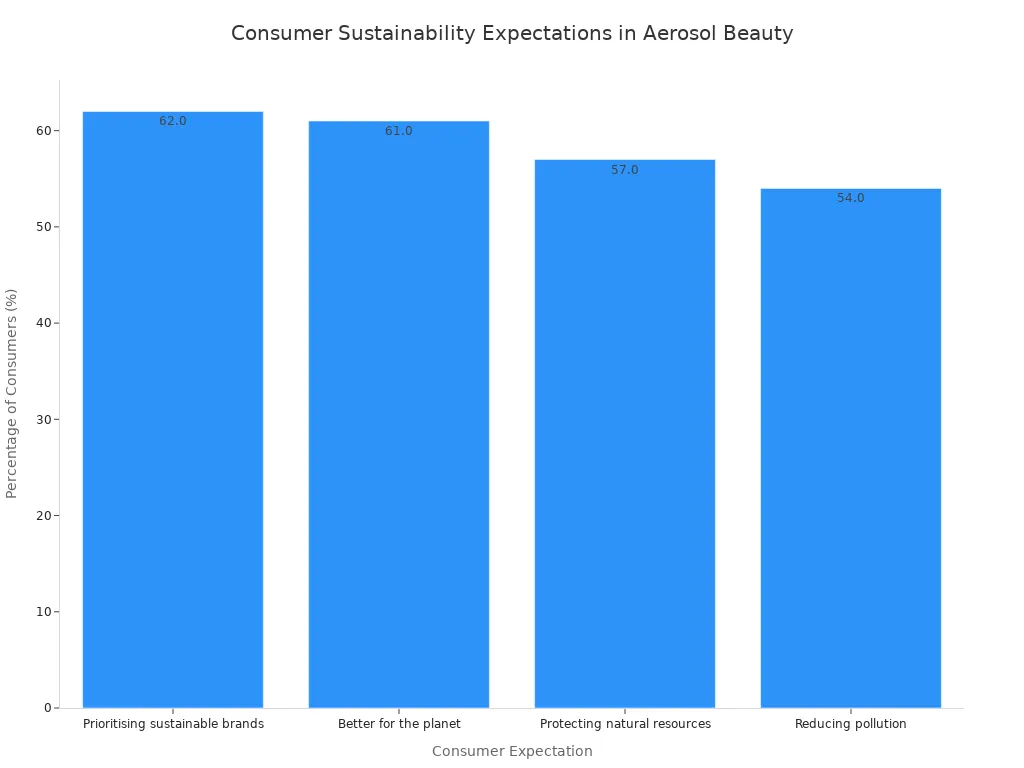
You should build your sustainability story into the package itself. Pair a low-GWP propellant with a recyclable container, then state both claims clearly on the label. SiHai helps you match propellant, valve, and container choices to the claims you plan to make, so your eco-friendly design holds up under consumer scrutiny.
FAQ
Which propellant works best for a beauty aerosol?
You match the propellant to your formula and spray goal. Hydrocarbons give low-cost, consistent delivery. DME suits water-based products. Compressed gases support non-flammable, eco-focused designs. SiHai helps you test and select the right match.
When should you choose Bag-on-Valve for a cosmetic aerosol?
You choose BOV when your formula is oxygen-sensitive, sterile, or premium. The inner bag separates product from propellant. This design protects actives, extends shelf life, and supports compressed-air or nitrogen pressurization.
How do you customize spray patterns for brand identity?
You tune three levers: propellant pressure, actuator orifice geometry, and formulation viscosity. Swirl-chamber actuators deliver fine, premium mists. SiHai supplies actuators and valves that make your chosen sensory signature repeatable at production scale.