The four standard aerosol can diameters are 45mm, 52mm, 57mm, and 65mm. Your fill volume, product type, valve, and filling line determine the right one. Match diameter to target fill volume first, then confirm valve compatibility and line constraints. This aerosol can size guide shows where each diameter fits best. SiHai stocks all four sizes, so you can compare and validate in one place.
| Diameter | Typical Fill Volume | Key Characteristics |
|---|---|---|
| 45 mm | 50 ml – 150 ml | Travel-size, personal care, pharmaceutical; slender and highly portable; often seamless aluminum |
| 52 mm | 150 ml – 400 ml | General purpose, household, personal care; comfortable grip, standard size; aluminum or tinplate steel |
| 57 mm / 60 mm | 400 ml up to 600 ml or more (depending on can height) | Selected when greater fill volume is required |
| 65 mm ("211") | Not specified | Largest common diameter; reserved for products where maximum volume is the primary goal |
Key Takeaways
- Start with your target fill volume to pick the right can diameter.
- Confirm valve fit and filling line compatibility before you finalize your choice.
- Validate the full pack—can, valve, actuator, and propellant—with your supplier.
Aerosol Can Size Guide: Quick Comparison at a Glance

Diameter vs. Typical Capacity
Diameter sets the footprint of your can. Height then determines the final fill volume. Use this aerosol can size guide as a starting reference for your project.
| Diameter | Typical Fill Volume | Common Material |
|---|---|---|
| 45 mm | 50–150 ml | Seamless aluminum |
| 52 mm | 150–400 ml | Aluminum or tinplate steel |
| 57 mm | 400–600 ml | Aluminum or tinplate steel |
| 65 mm | 600 ml and above | Tinplate steel |
Best-Fit Product Categories
Each diameter serves a distinct product zone. The 45 mm can suits travel-size deodorants, pharmaceutical sprays, and sample packs. The 52 mm can covers general-purpose household products and personal care items. The 57 mm can handles larger personal care formats and mid-volume household lines. The 65 mm can fits high-volume industrial and technical products. SiHai supplies all four diameters, so you can source your full range from one partner.
Key Takeaways
Start with your target fill volume. Then confirm valve fit and filling line compatibility. A larger diameter does not automatically mean a better choice. The right can matches your product, your propellant system, and your equipment. Keep this aerosol can size guide handy as you narrow your options.
Key Factors in Choosing a Can Size
Four factors drive every can size decision: fill volume and headspace, propellant system, valve compatibility, and filling line constraints. You can treat them as a sequence. Volume narrows the diameter range first. The other three factors confirm or eliminate your shortlist. SiHai helps you run this sequence across all four standard diameters, so you reach a validated choice faster.
Fill Volume and Headspace
Fill volume is your starting point. Decide how much product the can must deliver per use cycle and per unit sold. That number points to one or two candidate diameters. A 45 mm can holds roughly 50–150 ml. A 52 mm can holds roughly 150–400 ml. A 57 mm can holds roughly 400–600 ml. A 65 mm can hold 600 ml and above. Height adjusts the exact figure within each range, so diameter sets the footprint and height sets the final volume.
Headspace matters as much as the fill itself. You need enough room above the liquid for the propellant vapor phase and for expansion across temperature swings. A can filled too close to the top leaves no room for the propellant to work. A can with excessive headspace wastes volume and can affect spray performance. Standard fill ratios exist for each diameter, and SiHai can share the recommended fill window for your specific can and valve combination.
Propellant System
Your propellant choice shapes the pressure profile inside the can. Compressed gases, liquefied gases, and soluble gas systems each behave differently. Liquefied propellants maintain constant pressure as the can empties. Compressed gases drop in pressure with each use. The pressure profile then determines the wall strength you need, and wall strength ties back to diameter and material.
Smaller diameters handle higher relative pressures well because the cylindrical shell carries hoop stress efficiently. Larger diameters need thicker walls or stronger materials to hold the same pressure. This relationship explains why 45 mm cans often use seamless aluminum and why 65 mm cans typically use tinplate steel. Match your propellant system to a can rated for its pressure range, and confirm the rating with your supplier before you commit.
Valve Compatibility
The valve is where can geometry meets function. Valve mounting cups come in a few standard sizes, and each must match the can neck precisely. The most common sizes are one-inch valves and 20 mm valves, with special 13 mm valves for niche formats. A 0.1 mm crimp-depth mismatch can compromise seal integrity, so neck and cup geometry must align exactly.
Valve type adds a second layer of matching. By spray method, valves fall into three groups:
- Dosing (metered) valves release a fixed amount per actuation.
- Continuous valves release product for as long as the actuator is held.
- Full-release valves discharge the entire contents in one action.
The table below shows how common valve types map to can diameters.
| Valve type | 1-inch (25.4 mm) | 20 mm | Specialty diameters |
|---|---|---|---|
| Continuous | Available | Not specified | Requires custom tooling |
| Metered | Available | Used in metered dose inhalers and some personal care | Requires custom tooling |
| Foam | Not a separate valve type — a spray-pattern variation of continuous valves (via product-to-propellant ratio and porous/mechanical breakup actuator) | — | — |
Foam output deserves a note. You do not need a separate foam valve. You achieve foam through the product-to-propellant ratio and a porous or mechanical breakup actuator on a continuous valve. This flexibility means most foam products fit standard one-inch valve platforms across the 45 mm to 65 mm range.
Filling Line Constraints
Your filling line sets hard limits on what you can run. Check three things before you finalize a diameter. First, confirm your crimper and filler accept the can neck diameter and valve cup size. Second, confirm your conveyor rails and change parts handle the can body diameter. Third, confirm your line speed targets match the can size, because smaller cans often run at different rates than larger ones.
Changeover cost matters too. A line tooled for 52 mm cans may need new guides, crimp heads, and nozzles to run 65 mm cans. If you plan to offer multiple sizes, choose equipment with quick-change capability. SiHai stocks all four standard diameters and supports sample runs, so you can test each size on your actual line before you scale up. Use this aerosol can size guide as your reference through that validation.
45mm Cans: Compact and Precise
Typical Applications
The 45mm can serves products that demand portability and precise dosing. You will find this diameter in travel-size deodorants, sample packs, pharmaceutical sprays, and cosmetic mists. Metered-dose formats also favor this size. The slender body fits easily into a bag or pocket. Brands use it for trial sizes and promotional lines. SiHai supplies 45mm cans in seamless aluminum, a material that supports clean dispensing and a premium finish.
Capacity Range and Specifications
This diameter typically holds 50 ml to 150 ml. Can height adjusts the exact fill volume within that window. The table below summarizes the core specifications.
| Parameter | Typical Value |
|---|---|
| Fill volume | 50–150 ml |
| Common material | Seamless aluminum |
| Valve platform | 20 mm or 1-inch |
| Best fit | Travel, personal care, pharmaceutical |
Confirm the recommended fill window and headspace with your supplier before production. SiHai shares these figures for every can and valve pairing.
Pros and Cons
The 45mm aluminum can offers clear strengths. It delivers excellent portability and precise dosing. Aluminum construction gives a smooth, corrosion-resistant interior. The small footprint reduces material use per unit. On the other hand, the low fill volume limits cost efficiency for high-volume products. The narrow body also restricts label space. Use this aerosol can size guide to weigh these trade-offs against your product goals. For compact formats, the 45mm can remains a strong fit.
52mm Cans: The Versatile Middle
Typical Applications
The 52mm can covers the widest product range of the four diameters. You will find it across personal care, household chemicals, and automotive lines.
| Industry | Typical Applications |
|---|---|
| Personal Care | Deodorants, hairsprays, shaving foams |
| Household Chemicals | Air fresheners, furniture polish, cleaning sprays |
| Automotive | Lubricants, penetration oils, spray paints |
Niche formats also fit this diameter well:
- Precision electronics and automotive detailing: contact cleaners, lock lubricants, and pin-point anti-seize sprays, often paired with long straw nozzles for tight-space work.
- Cabin care and spot treatments: interior odor eliminators, air conditioner sanitizer foams, and leather care sprays, typically 200ml–350ml.
- Household and insecticides: mosquito repellents, bug sprays, and room fresheners for frequent home use.
SiHai stocks 52mm cans in aluminum and tinplate steel, so you can match material to your product chemistry.
Capacity Range and Specifications
The 52mm (202) diameter is a standard aerosol can size with a capacity range of 4oz to 30oz, or roughly 145ml to 485ml in full-capacity volumes. Can height drives the exact figure, and the available height range is 73–240mm.
| Specification | Value |
|---|---|
| Diameter | 52mm (202) |
| Can type | Neck-in |
| Body thickness | 0.18–0.21mm |
| Height range | 73–240mm |
| Buckling pressure | ≥1.2 MPa |
| Burst pressure | ≥1.4 MPa |
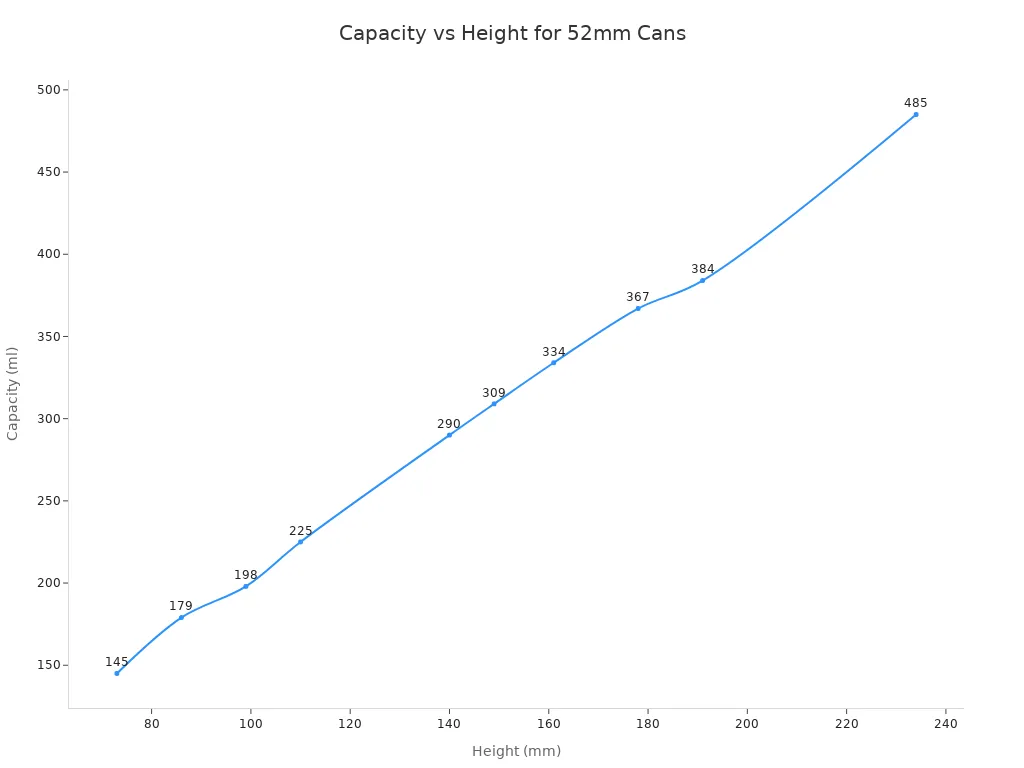
Common formats include 145ml (52 x 73mm), 290ml (52 x 140mm), and 485ml (52 x 234mm). Use this aerosol can size guide to compare heights against your target fill.
Pros and Cons
This diameter balances capacity and handling. It offers a comfortable grip, broad valve compatibility, and strong availability. The mid-range volume suits both trial and full-size formats. The trade-off is that it sits between two extremes: it holds less than a 65mm can and takes more shelf space than a 45mm can. For most general-purpose products, though, the 52mm can is the practical default.
57mm Cans: Balanced Capacity
Typical Applications
The 57mm can sits between the 52mm and 65mm formats. It suits products that need more volume than a mid-size can delivers, without the bulk of the largest diameter. You will find this size in family-size deodorants, larger hairspray formats, and mid-volume household lines. Air fresheners, insect repellents, and multi-use cleaning sprays also fit well here. Brands choose it for value packs and refill-style offerings. SiHai supplies 57mm cans in aluminum and tinplate steel, so you can match the material to your formulation.
Capacity Range and Specifications
This diameter typically holds 400 ml to 600 ml. Can height sets the exact fill volume within that window. The table below summarizes the core specifications.
| Parameter | Typical Value |
|---|---|
| Fill volume | 400–600 ml |
| Common material | Aluminum or tinplate steel |
| Valve platform | 1-inch |
| Best fit | Family-size personal care, mid-volume household |
Confirm the fill window and headspace with your supplier before production. SiHai shares these figures for every can and valve pairing.
Pros and Cons
The 57mm can offers a strong capacity-to-footprint ratio. It holds noticeably more product than a 52mm can while keeping a manageable body diameter. Shelf presence improves without a jump to the largest format. Valve compatibility stays broad on the standard 1-inch platform. The trade-off is narrower availability than the 52mm size, and the higher fill volume raises per-unit material cost. For products that need mid-to-high volume, this diameter earns its place. Use this aerosol can size guide to compare it against your target fill.
65mm Cans: Maximum Volume
Typical Applications
The 65mm can serves products that demand maximum volume and a durable structure. You will find this diameter in professional-grade spray lines and high-volume technical products. The table below maps common uses by category.
| Application Category | Typical 65mm Aerosol Can Uses |
|---|---|
| Car care | Leather care sprays, interior fragrance sprays |
| Industrial chemicals | Spray paint, mold release agents, brake cleaner, insecticide |
| Structural note | Straight-wall 65mm cans offer maximum volume at cost-effective pricing, making them ideal for industrial spray paints and technical cleaners |
Common applications also include:
- Spray paints
- Automotive care products
- Industrial cleaners
These cans earn their place through larger product capacity and a strong, durable body. SiHai supplies 65mm cans in tinplate steel, a material that supports the pressure demands of technical formulations.
Capacity Range and Specifications
This diameter typically holds 600 ml and above. Can height sets the exact fill volume. The table below summarizes the core specifications.
| Parameter | Typical Value |
|---|---|
| Fill volume | 600 ml and above |
| Common material | Tinplate steel |
| Valve platform | 1-inch |
| Best fit | Industrial, technical, high-volume products |
Confirm the fill window and headspace with your supplier before production. SiHai shares these figures for every can and valve pairing.
Pros and Cons
The 65mm can delivers the highest capacity of the four standard diameters. It reduces fill cost per unit and gives strong shelf presence. The straight-wall design supports efficient labeling and a sturdy structure. The trade-off is a larger footprint and higher material use per can. This diameter suits products where volume is the primary goal. Use this aerosol can size guide to confirm the 65mm can matches your target fill.
What Is the Difference Between 45mm and 52mm Cans?

The 45mm and 52mm cans sit closest together in the lineup, yet they serve different jobs. This aerosol can size guide breaks down the trade-offs so you can pick with confidence.
Capacity and Portability Trade-Offs
The 45mm can wins on portability. Its slim body fits smaller hand grips, and the lightweight profile lowers unit logistics costs. The 52mm can optimizes internal volume while keeping high portability. The table below compares the two diameters side by side.
| Caliber | Portability / Handling | Suggested Capacity Range | Typical Applications |
|---|---|---|---|
| 45mm | Fits smaller hand grips; lightweight profile that lowers unit logistics costs | 50ml – 150ml | Travel body lotions, after-sun cooling sprays, dry shampoos |
| 52mm | Optimizes internal volume while retaining high portability | 100ml – 250ml (home/cleaning); 150ml – 300ml (automotive/industrial) | Electronics/PC cleaners, carpet spot removers, automotive precision contact sprays, valve lubricants |
The necked-in (NI) can design reinforces portability on both sizes. Recessing the valve and actuator helps prevent accidental discharge during transit or in crowded toolboxes. This design also supports leak-proof, consistent spray performance. You get reliable output for TSA-compliant travel sizes and one-handed use in cramped spaces.
When Each Diameter Fits Best
Choose the 45mm can for travel formats, sample packs, and products where pocketability matters most. Choose the 52mm can when you need more volume without sacrificing handling. SiHai stocks both diameters, so you can compare samples and validate the full pack before production.
Matching Size to Product Type
Product type narrows your diameter choice quickly. Use this aerosol can size guide to align each category with the right can.
Personal Care
Personal care formats split into two clear groups. Travel-size aerosols—mini hairspray, travel deodorant spray, dry shampoo—typically hold 3.4 ounces (100 milliliters) or less. That ceiling keeps them compliant with TSA rules, and the 45mm can fits this zone well. Full-size deodorants, hairsprays, and shaving foams land in the 150–400 ml range, where the 52mm can delivers a comfortable grip and broad valve compatibility. Family-size formats move up to the 57mm can.
| Product | Carry-On Limit | Checked Luggage Limit |
|---|---|---|
| Hairspray | Max 100 ml per container (in a 1-liter bag) | Max 500 ml per can; total max 2 liters or 2 kg per person |
| Deodorant (Spray) | Max 100 ml per container (in a 1-liter bag) | Max 500 ml per can; total max 2 liters or 2 kg per person |
| Aerosol toiletries (general) | Max 100 ml per container | Max 500 ml per can; total max 2 liters or 2 kg per person |
Stock can sizes for personal care sprays range from 202 to 300 diameter, which gives you flexibility across these formats. SiHai stocks all four standard diameters, so you can cover travel and full-size lines from one supplier.
Household Products
Household products favor the middle diameters. Air fresheners, furniture polish, and cleaning sprays typically fit the 52mm can. Mid-volume lines and value packs move to the 57mm can. Both sizes accept standard 1-inch valves, which keeps your component sourcing simple.
Industrial and Technical
Industrial and technical products prioritize volume and durability. Spray paints, brake cleaner, mold release agents, and insecticides fit the 65mm can. This straight-wall format delivers maximum capacity at cost-effective pricing. SiHai supplies 65mm cans in tinplate steel to handle the pressure demands of technical formulations.
Standard vs. Custom Sizes
When Standard Sizes Work Best
Standard diameters cover most aerosol products. You gain faster lead times, lower tooling cost, and broad component availability when you choose a 45mm, 52mm, 57mm, or 65mm can. These four sizes accept common valve platforms, so you avoid custom neck tooling and long development cycles. Standard cans also simplify your filling line setup. Your crimper, conveyor rails, and change parts likely already handle at least one of these diameters.
Custom sizes make sense in narrow cases. You need a distinctive shelf profile, or your fill volume falls between two standard ranges. Even then, confirm the custom tooling cost against your expected volume. For most projects, a standard diameter with an adjusted can height delivers the target fill volume at far lower cost. SiHai stocks all four standard diameters, so you can test height variations before you consider custom tooling.
Validating the Complete Pack
A can diameter alone does not guarantee performance. You must validate the full pack: can, valve, actuator, and propellant together. Run these checks before you commit to production:
- Confirm the valve cup crimps to the can neck within specification.
- Test spray rate, pattern, and foam quality with your actual formulation.
- Verify pressure ratings across your expected temperature range.
- Run a line trial at your target speed.
SiHai supports full-pack validation across all four standard diameters. You can compare samples, confirm compatibility, and scale up with confidence.
Regulatory and Safety Considerations
Pressure and Testing Requirements
Aerosols ship as dangerous goods. Both the US DOT and the international UN Model Regulations require every container to meet defined pressure and testing standards before transport. An uncertified can removes the safety margin your product design relies on. Always use certified cans and valves.
Your testing plan should cover four checkpoints. The table below shows each one and its purpose.
| Check | Purpose |
|---|---|
| Can selection | Match can to validated pressure profile |
| Propellant validation | Pressure testing for concentration |
| Crimping and valves | Integrity checks every batch |
| QC documentation | Weight, pressure, and leak test logs |
Material choice affects pressure performance. Tinplate steel stays strong under internal pressure, and it needs a suitable protective coating where moisture or reactive ingredients threaten corrosion resistance. Aluminum alloy is lightweight and corrosion resistant, yet you still need compatibility testing for product chemical reactivity. For refillable setups, assess refill cycles for metal fatigue, not just initial burst strength.